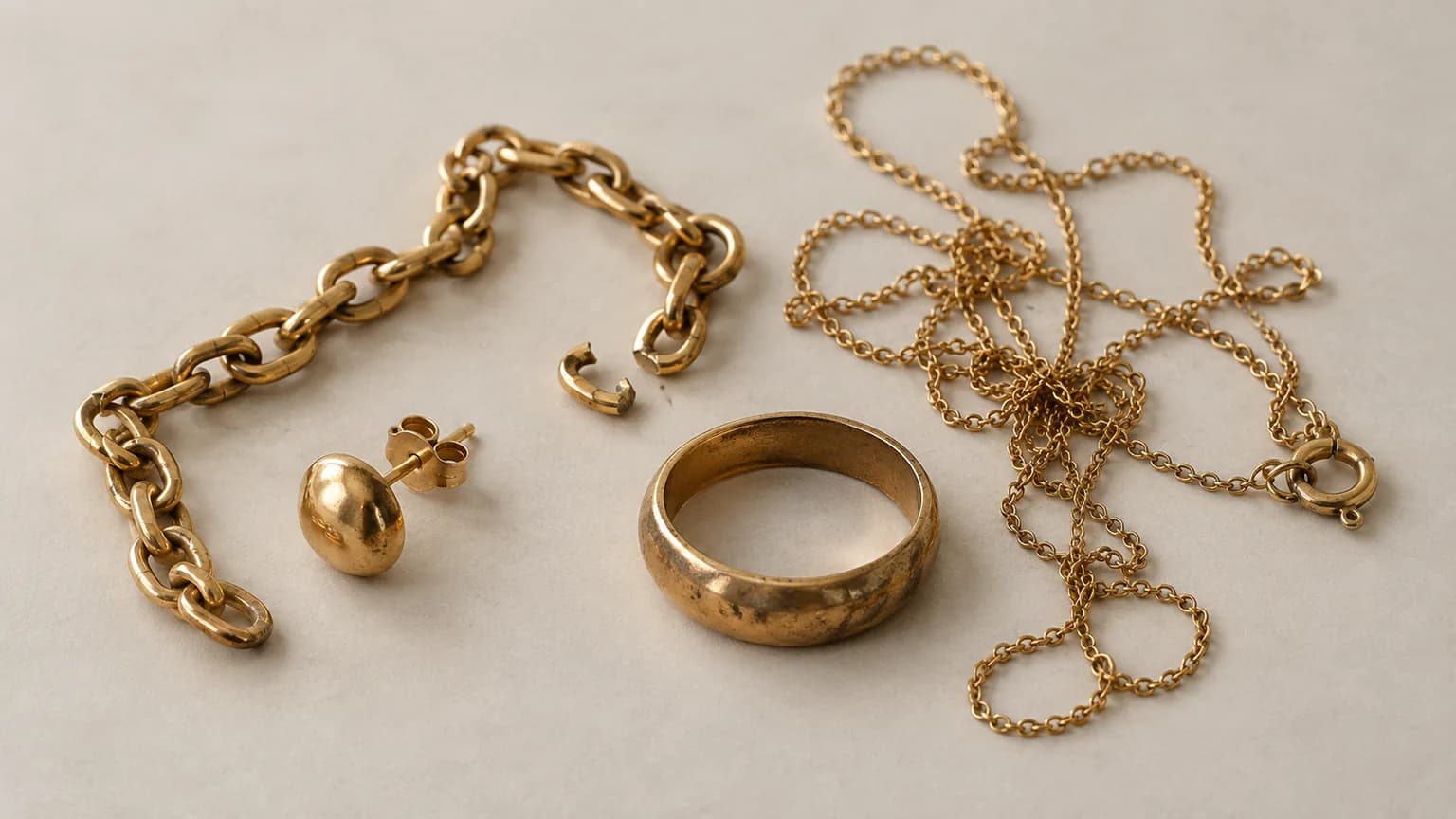
Why Condition Doesn't Change the Payout
If your pieces came from a secondhand lot, see our guide to gold found at estate sales, thrift stores, and storage auctions.
Your payout is based on weight and karat, not appearance.
- A broken clasp, missing partner earring, or bent prong doesn't remove any gold from the piece. The metal is all still there
- Tarnish and discoloration are surface-level, and don't reduce the actual gold content underneath
- A piece that no longer functions as wearable jewelry still functions perfectly well as scrap gold, which is priced purely on its metal
- The only things that actually matter are how much it weighs, its karat, and the current spot price, not its condition, style, or whether it's currently "wearable"
Real Gold vs. Gold-Plated or Gold-Filled
We buy real, solid gold, priced by its actual karat. Plated and filled pieces are worth far less, since only a thin layer (or none) is actual gold.
- We buy any karat, from 6K up to 24K (pure gold). Common stamps include 10K, 14K, 18K, 22K, or a 3-digit fineness number like 585 or 750
- Gold-plated or gold-filled pieces are usually marked GP, GF, RGP, HGE. These have a thin gold layer over a base metal, so they aren't solid gold, and we don't purchase them. We'll always tell you plainly if that's what you're holding instead of pretending otherwise.
- Not sure which one you have? Our full guide to spotting real gold covers exactly how to read these stamps, plus what to do if there's no stamp at all
- Condition (broken, tangled, tarnished) never changes this distinction. It's about what the piece is made of, not what shape it's in
Do I Need to Clean or Repair It First?
No. Don't bother, and don't use harsh chemicals.
- Cleaning doesn't add value, since we test and weigh the actual metal regardless of surface condition
- Aggressive polishing chemicals or DIY cleaning methods can occasionally damage stones or plating on mixed pieces, so skip it
- Repairing a broken clasp or chain before selling costs you money for zero return, since we're not paying for it as functional jewelry
- Send it exactly as it is
What Counts as Sellable Gold
If it's gold, condition doesn't disqualify it. Common examples:
- Broken or snapped chains and bracelets
- Single earrings with a missing partner
- Bent, dented, or out-of-round rings
- Tangled necklaces you've given up on untangling
- Tarnished or discolored pieces that don't look like gold anymore
- Old class rings, pins, or pieces that are simply out of style
What If I Don't Know Whether It's Real Gold?
Check for a stamp, but don't worry if you can't find or read one.
Look for a small karat stamp (anywhere from 6K to 24K, commonly 10K, 14K, 18K, or 22K) or a 3-digit number (like 585 or 750), usually inside a ring band or near a clasp. If it's worn smooth, tangled up with other pieces, or you're just not sure, that's completely normal and doesn't stop you from sending it in.
Here's the full guide to spotting real gold and reading stamps, including what to do if there's no stamp at all. Either way, we test every item for real purity and weight, so you don't need to figure it out yourself before sending it in.
You can send a whole drawer, real and fake mixed together. No need to sort it first. Your offer comes with a full itemized breakdown showing exactly what qualified as gold (with karat and weight for each piece) and what didn't, so you'll know precisely what you're being paid for.
Combine Small Pieces for a Real Payout
One tangled chain might not feel like much. A drawer full of them usually is.
Gold accumulates in small amounts over the years: an old chain here, a single earring there, a class ring from decades ago. Individually these can feel too minor to bother with. Combined, they add up to real weight, and therefore real money. See how the math works once you total up what's actually in that drawer.
Packaging Loose or Broken Pieces
Group small or loose items together so nothing gets separated in transit.
- Put loose pieces (single earrings, small chains, broken links) in a small bag or envelope before placing them in your kit
- No need to sort real from costume, or gold from gold-plated. Just send it all together
- Choose the kit format that fits your timeline: a print kit you can download and mail today, an email kit sent straight to your inbox to print, or a physical kit mailed to you (typically 3-5 days to arrive) with everything included to package your items. All three ship back to us free, prepaid
Ready to Turn That Drawer Into Cash?
Send in everything: broken, tangled, tarnished, mismatched, all of it. No cleaning, no sorting, no repairs needed. We test every piece for real purity and weight and send you a clear, itemized offer. No obligation, and everything ships back free if you decline.
Free protected shipping · Written offer within 24 hours · Everything returned free if you decline.
Frequently Asked Questions
No. We test and weigh the actual gold content regardless of condition, so cleaning or repairing beforehand doesn't add value. It just costs you time and, in some cases, risks damaging the piece further.
Yes. A broken clasp or a tangled mess doesn't remove any gold from the chain. It's priced the same as an intact chain of the same karat and weight.
That's fine. You don't need to figure it out yourself. Check for a karat stamp if you can find one, but if it's worn, tangled, or unclear, send it in anyway. We test every item for real purity and weight.
It helps but isn't required. Grouping small items like single earrings or broken links into a small bag or envelope inside your kit keeps everything together in transit, but even if you send it all loose, every piece still gets tested and weighed individually.