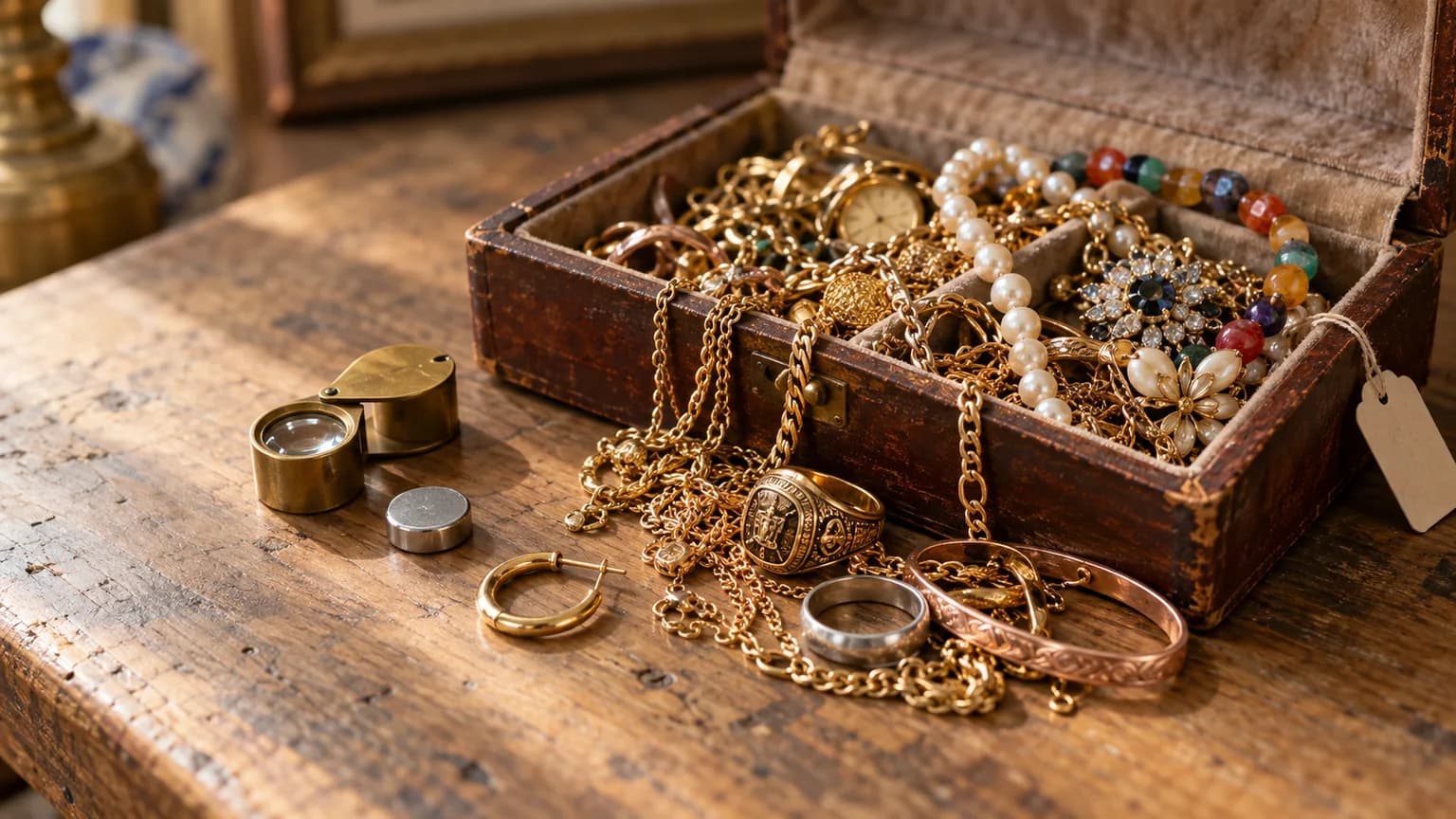
Why Real Gold Ends Up in Secondhand Lots
Most sellers price by look, not by metal, and that's where the opportunity is.
- Estate sales: families clearing a household are often working fast and pricing a full jewelry box as costume jewelry, without testing anything
- Thrift stores: donated jewelry gets sorted quickly by staff who usually aren't trained to test metal, so solid gold ends up in the same bin as fashion jewelry
- Storage auctions: you buy the whole unit sight unseen, and jewelry boxes, dresser drawers, and loose bags of chains are among the most commonly reported valuable finds
- Garage sales and flea markets: same reason as estate sales, the seller often doesn't know what they have
The Pieces Most People Overlook
Experienced pickers check these first, because casual sellers miss them.
- White gold: looks like silver, so it's routinely priced as silver or costume. Look for a 10K, 14K, 18K, 585, or 750 stamp on silver-colored pieces
- Rose gold: its pinkish, coppery tone can be mistaken for copper or costume jewelry. It's real gold alloyed with copper, stamped and priced the same way as yellow gold
- Men's items: class rings, cufflinks, tie clips, and signet rings are often solid and surprisingly heavy
- Tangled chains: a knotted clump in the bottom of a jewelry box gets skipped because it looks like junk. Condition doesn't matter; broken and tangled gold sells by weight just the same
- Single earrings and charms: small, but often solid gold, and they add up
- Old watch cases: some vintage watch cases are solid gold even when the movement no longer works. Check inside the case back for a karat stamp
Reading Stamps on Secondhand Pieces
Secondhand lots are full of older and foreign jewelry, and their stamps don't always look like modern US ones.
- 3-digit numbers are purity marks: older and foreign pieces often use a number instead of a karat letter. 375 is common on British pieces, 916 on South Asian and Middle Eastern pieces, and 585 or 750 across Europe
- Italian gold is often stamped 750 or 585 alongside a small star and a maker's code, which is a good sign of a genuine piece
- "Made in Italy" or "Italy" alone is not a purity mark. Plenty of plated and silver jewelry is made in Italy too
For where to find the stamp, the complete karat-by-karat chart, and the markings that mean plated or gold-filled, see our full guide to spotting real gold.
What to Bring to a Sale
A few small tools let you check pieces on the spot, before you pay.
- A strong magnet: solid gold isn't magnetic, so anything that jumps to a neodymium magnet can be ruled out immediately. Here's how to use the magnet test correctly, including the clasp mistake that fools people
- A loupe or your phone's zoom: stamps are often under a millimeter tall and worn on older pieces
- A small digital scale in grams: the single most useful tool for estimating what a lot is worth
- Watch for hollow pieces: some chains and hoops are hollow, so they look big but weigh very little. Payout is based on actual gold weight, not size
Know Your Numbers Before You Bid
If you're buying lots to resell, estimate the gold value before you set your price.
A simple way to estimate a piece's pure gold content:
Weight in grams × gold content % = grams of pure gold
For example, a 14K piece (58.3% gold) that weighs 4 grams contains about 2.3 grams of pure gold. From there, today's spot price tells you what that gold is worth on the market, and no buyer pays full spot for scrap jewelry, so set your bid with room below that number.
- Older receipts and appraisals may list pennyweight (dwt): 1 dwt = 1.555 grams
- Don't count stones or non-gold parts toward weight: only the gold itself is paid for
See the full payout breakdown for how karat, weight, and spot price turn into an actual offer.
When Not to Sell a Piece for Its Gold
Some finds are worth more as jewelry than as metal. Check first.
- Signed designer pieces from known jewelry houses can sell for far more than their gold weight on the resale market
- Genuine antiques with craftsmanship, age, or historical interest may carry collector value
- Pieces with significant gemstones: our offer is based on gold content, so a valuable stone should be appraised separately before you decide
- Rare coins: some gold coins carry collector premiums well above their gold value
If something looks special, get a retail appraisal before selling it to any buyer that pays by gold content, including us. For everything else, which is most of what turns up in secondhand lots, gold value is the value.
Not Sure What You Bought? Send It In
No sorting needed. Every piece is tested and itemized.
Send your finds exactly as they are, including anything uncertain. Your offer lists each piece with its tested karat and weight, and clearly shows anything that isn't gold. Here's how the process works, start to finish.
If the jewelry came from your own family rather than a sale, see our guide to selling inherited or estate gold.
Ready to Cash In What You Found?
Send in your finds, one standout piece or a whole batch. We test everything and send you a clear, itemized offer. No obligation, and everything ships back free if you decline.
Free protected shipping · Written offer within 24 hours · Everything returned free if you decline.
Frequently Asked Questions
Yes, at the same karat and weight. White gold is real gold alloyed with white metals, and it's priced by its gold content just like yellow or rose gold. It's also the piece most often mistaken for silver at thrift stores and estate sales.
Weigh each piece in grams and multiply by its gold content: about 41.7% for 10K, 58.3% for 14K, and 75% for 18K. That gives you grams of pure gold, which you can compare against the day's spot price. Keep your bid well below that number, since no buyer pays full spot for scrap jewelry.
Not before getting it appraised. Signed designer pieces and genuine antiques can be worth far more as jewelry than as gold, so check their resale value first. For unsigned, everyday pieces, gold value is usually the real value.
No. Older and foreign pieces are tested and priced the same way, by actual purity and weight. They often use a 3-digit fineness stamp like 375, 585, 750, or 916 instead of a karat letter.
Yes. There's no need to sell each piece separately. One standout piece or a batch from multiple sales works the same way.